

PHOENICIA
Built by hand in Syria from archaeological evidence. Sixty-five feet. Fifty tons. One square sail. Then Phoenicia went where a museum replica usually never goes: to sea—around Africa and across the Atlantic. Now her final voyage is preservation.
▶ Watch opening film with soundA ship.
A story.
A legacy.
Phoenicia began with a deceptively simple question: what could a vessel built from a 6th-century BC evidence base actually do if it were rebuilt at full scale and taken back to sea?
Commissioned by Philip Beale, the ship was built in 2007–08 on Arwad Island, Syria, by Khaled Hammoud and his family of traditional shipwrights. The design drew primarily on the Jules Verne 7 wreck from around 600 BC, excavated at Marseille, together with other archaeological evidence and specialist advice. Aleppo pine was the principal timber, alongside other Mediterranean woods, olivewood tenons and iron nails.
BUILT FROM ANCIENT KNOWLEDGE.
SAILED BY COURAGE.
PRESERVED FOR GENERATIONS.
What began as an archaeological question became a living experiment: Syrian shipwrights, international crews, two major expeditions and more than 30,000 nautical miles. Phoenicia is now two stories at once—the ancient technology she was built to investigate and the remarkable modern voyages written into her own timbers.
The sea was not scenery.
It was the experiment.
Phoenicia was not built merely to look plausible at a dock. She was built to test capability. Wind, current, storms, repairs, navigation, crew endurance and thousands of miles of open water supplied the evidence.
Around a continent.
From Syria, Phoenicia passed through Suez and into the Red Sea, continued around the African coastline and Cape of Good Hope, then worked north through the Atlantic, Gibraltar and the Mediterranean. The expedition covered more than 20,000 miles and remains an extraordinary modern test of an ancient-style vessel.
20,000+ MILES2008–2010Across an ocean.
Leaving Carthage in 2019, Phoenicia called at historic Atlantic ports before departing Tenerife for the Caribbean. After 39 days across the Atlantic she reached Santo Domingo on December 31, then continued to Fort Lauderdale, Florida, arriving February 4, 2020.
6,000+ MILES5 MONTHS39-DAY CROSSINGThey demonstrated capability: a vessel reconstructed from a circa-600 BC Mediterranean evidence base could survive demanding long-distance ocean passages. The voyages do not, by themselves, prove that a particular ancient crew crossed the Atlantic. That distinction matters—and it makes Phoenicia a stronger piece of experimental archaeology, not a weaker one.
The 2019–20 expedition also collected microplastic data and supported the United Nations Environment Programme’s Clean Seas campaign, adding modern scientific work to the voyage.
Continuing Captain Philip Beale’s vision.
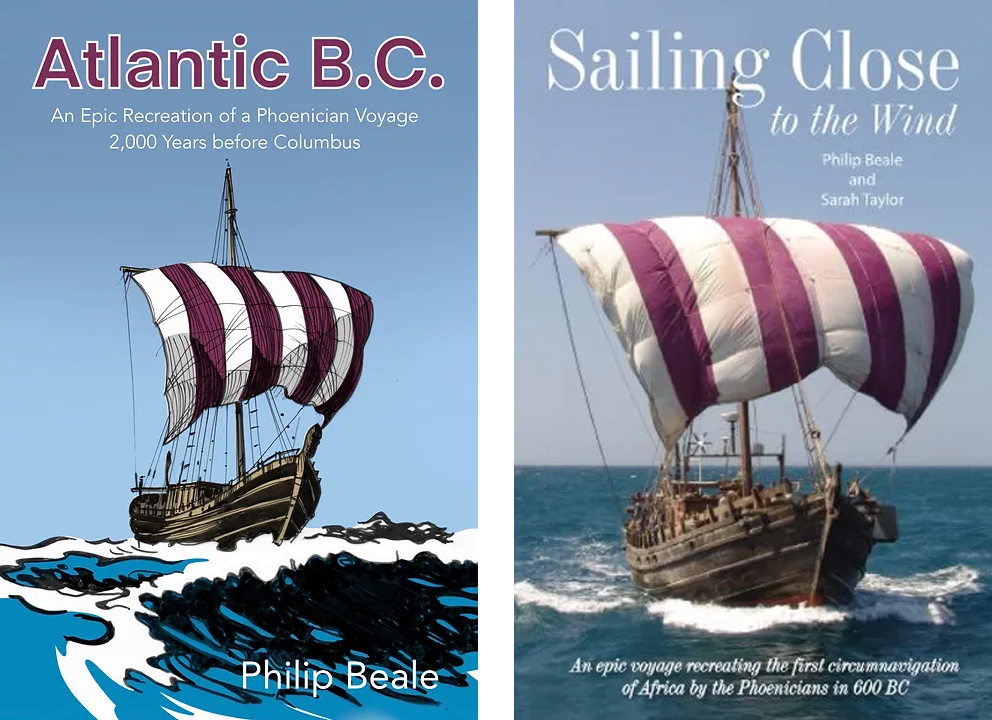
Philip Beale did not stop at asking whether ancient mariners could make extraordinary voyages. He built the experiment, assembled crews and went to sea. Before Phoenicia, he led the 2003–04 Borobudur Ship Expedition from Indonesia toward Africa, a project that earned him the President of Indonesia’s award for services to Indonesian culture.
With Phoenicia he went further: commissioning the ship, leading the 2008–10 Africa expedition and later the 2019–20 Atlantic crossing. His method was simple and demanding—move the question out of the lecture hall and into wind, weather and open ocean.
Today Beale remains part of Phoenicia’s living legacy as an Honorary Board Member of the museum project. The museum is the continuation of that same idea: test the past honestly, preserve the evidence carefully, and invite people to keep asking questions.
A ship only sails because people do.
Phoenicia was built by Syrian craftsmen and sailed by rotating international crews. The project brought together people from the United States, Lebanon, Tunisia, the United Kingdom, Norway, the Netherlands, Brazil, Indonesia and beyond. They brought different languages, professions and reasons for being there—but at sea, every person depended on the same hull, the same wind and one another.
The museum story should preserve more than timber. It should preserve the voices of the builders, sailors, filmmakers, researchers and volunteers who turned an archaeological question into a human adventure.
Don’t put history behind glass.
Put people inside the story.
The museum vision is immersive because Phoenicia herself is immersive. Visitors should feel the scale of a 65-foot wooden vessel, see how her joints work, hear what a storm sounded like to the crew and understand why a voyage that looks simple on a map could demand months of judgment and endurance.
Board Phoenicia
Walk the deck, stand near the helm and feel how large—and how exposed—a single-sail vessel really is.
Voyage Theater
Enter Africa and the Atlantic through expedition film, crew voices, weather, charts and moments when plans had to change.
Navigate by the Sky
Explore stars, sun, wind, current and coastline—and the knowledge required before GPS put a blue dot on a screen.
Build Like a Shipwright
See mortise-and-tenon joinery, timber selection, rope seams, rigging and the practical intelligence hidden inside the hull.
Follow the Trade World
Trace the Mediterranean ports, goods, languages and cultural exchanges that made Phoenician maritime networks possible.
Watch Preservation
See how 50 tons of voyage-worn timber are documented, conserved and prepared for a permanent life on land.
Her sailing days are over.
Her most important work may be ahead.
Phoenicia is now fully disassembled and stored in Utah. She will never be made seaworthy again. The task has changed from expedition to conservation: protect the original voyage-worn timbers, document what they carry, and reassemble the ship for permanent exhibition rather than another ocean crossing.
The ship that proved herself at sea can now become the place where a new generation discovers how ancient technology, modern courage and human curiosity meet.
Preserve the Evidence
Catalog, protect and conserve the original timbers, repairs and voyage marks that now belong to Phoenicia’s modern history.
Reassemble for Exhibition
Bring the 65-foot vessel back together as a permanent exhibit—not a seaworthy reconstruction—while retaining as much original material as possible.
Build the Experience Around Her
Use film, artifacts, navigation, shipbuilding, crew stories and hands-on learning to make the vessel understandable rather than merely impressive.
Built by modern hands.
Tested at sea.
Worth preserving.
Phoenicia is not only a reconstruction of an ancient idea. She is the surviving record of a modern experiment. Her timbers carry wear, repairs and decisions made across more than 30,000 nautical miles. Preserving the vessel means preserving both sides of that story.
Sea to Summit.
In 2034, Salt Lake City–Utah will host the Olympic and Paralympic Winter Games. That return of the world to Utah gives the Phoenicia Ship Museum a powerful horizon: preserve the vessel, build an unforgettable experience and be ready to tell an international story to an international audience.
Phoenicia Ship Museum is an independent museum project and is not presented here as an official Olympic or Paralympic program.
PHOENICIA SURVIVED THE OCEAN.
NOW WE HAVE TO SAVE THE STORY.
Fifty tons of hand-built history are already in Utah. The next voyage is not across water. It is from containers to conservation, from conservation to exhibition, and from exhibition into the memory of the people who encounter her.
HELP WRITE PHOENICIA’S NEXT CHAPTER.
She crossed oceans because people believed a question was worth testing. Her sailing days are finished. Whether the story survives now depends on people who believe that courage, craftsmanship and honest inquiry are worth passing forward.